> ## Documentation Index
> Fetch the complete documentation index at: https://docs.contextual.ai/llms.txt
> Use this file to discover all available pages before exploring further.
# Why Contextual AI
> What makes Contextual AI different and when to use it
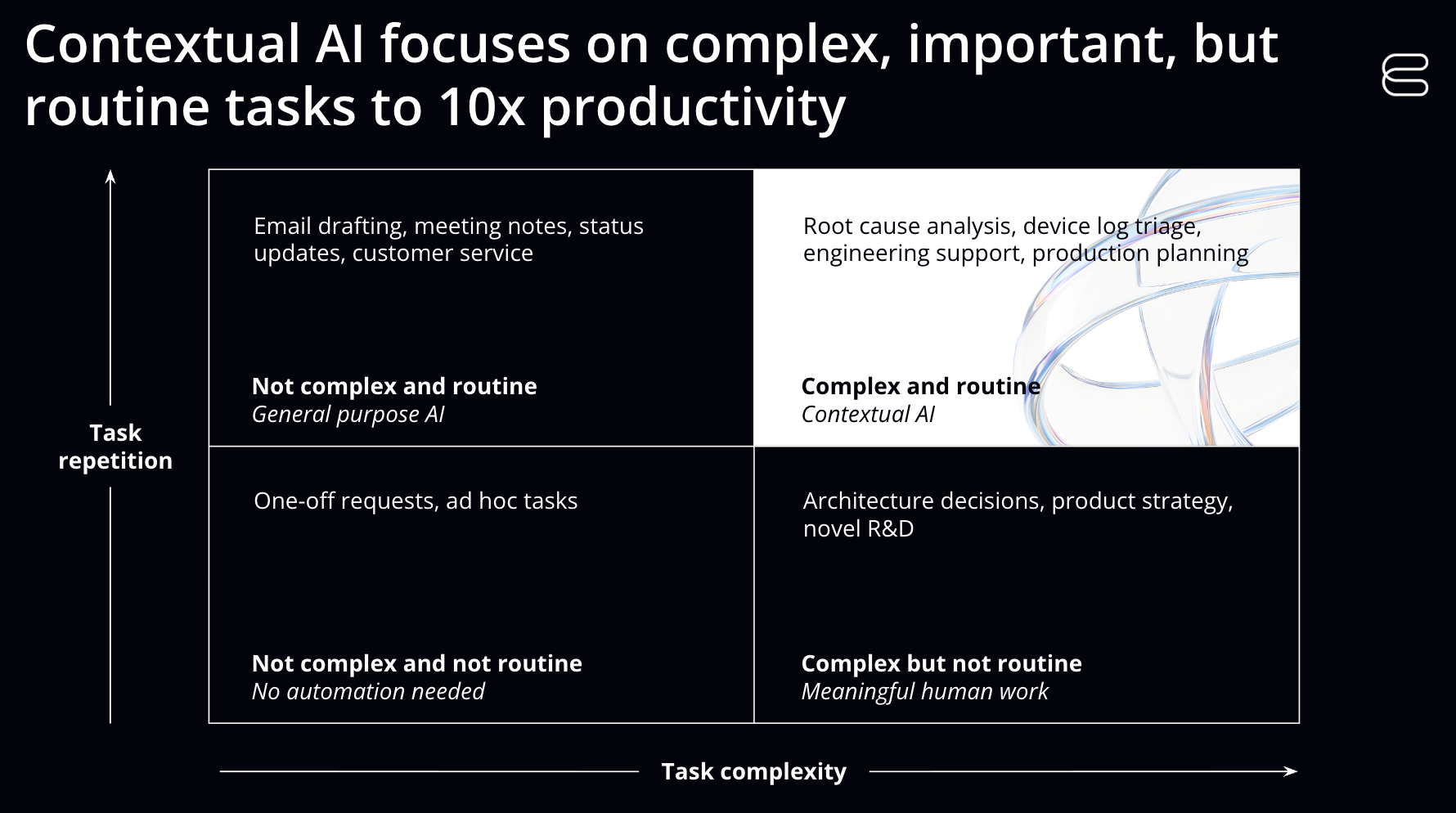
Contextual AI is built for tasks that are **both complex and routine**—work that requires deep domain expertise but happens frequently enough that the right automation delivers transformative results. If your team spends hours digging through technical documents, logs, or specifications to answer questions or make decisions, Contextual AI can reduce that to minutes.
 ***
## When to Use Contextual AI
Our platform excels at six canonical AI workflows that eliminate routine expert work:
| Workflow | Use Cases | Availability |
| :------------------------ | :--------------------------------------------------------------- | :----------- |
| **Basic Search** | Tech Customer Support, Consulting Proposal Generator | Self-Serve |
| **Agentic Search** | Drilling Operations Advisor, Supply Chain Risk Visualization | Self-Serve |
| **Root Cause Analysis** | Device Log Error Analysis, Process Safety Incident Investigation | Enterprise |
| **Deep Research** | Patent Reasoning Agent, Clinical Trial Research Agent | Enterprise |
| **Task Execution** | Equipment Failure Prediction, Maintenance Planning | Enterprise |
| **Structured Extraction** | Compliance Evidence Collection, Incident & Postmortem Analysis | Enterprise |
**Self-serve users** get immediate access to **Basic Search** and **Agentic Search** templates. These cover most Q\&A and multi-step retrieval use cases. Enterprise templates require a custom engagement—[contact us](https://contextual.ai/contact) to learn more.
***
## What's in Agent Composer
Agent Composer is the core interface for building and configuring agents on Contextual AI. [Read the launch announcement](https://contextual.ai/blog/introducing-agent-composer) to learn how it reduces complex technical tasks from hours to minutes.
It provides:
* **Pre-built agent templates** — Start with Basic Search or Agentic Search (self-serve) or use specialized templates for Root Cause Analysis, Deep Research, Task Execution, and Structured Extraction (enterprise).
* **Prompt-based generator** — Describe your use case in natural language and let the system generate an agent configuration.
* **Visual workflow builder** — Drag-and-drop interface for customizing agent behavior, adding tools, and defining multi-step workflows (enterprise).
* **APIs and Python SDK** — Programmatic access for integration into existing applications and automation pipelines.
The diagram below shows the full scope of Agent Composer capabilities across industry solutions, agent configuration, tools, security, and enterprise knowledge sources:
***
## When to Use Contextual AI
Our platform excels at six canonical AI workflows that eliminate routine expert work:
| Workflow | Use Cases | Availability |
| :------------------------ | :--------------------------------------------------------------- | :----------- |
| **Basic Search** | Tech Customer Support, Consulting Proposal Generator | Self-Serve |
| **Agentic Search** | Drilling Operations Advisor, Supply Chain Risk Visualization | Self-Serve |
| **Root Cause Analysis** | Device Log Error Analysis, Process Safety Incident Investigation | Enterprise |
| **Deep Research** | Patent Reasoning Agent, Clinical Trial Research Agent | Enterprise |
| **Task Execution** | Equipment Failure Prediction, Maintenance Planning | Enterprise |
| **Structured Extraction** | Compliance Evidence Collection, Incident & Postmortem Analysis | Enterprise |
**Self-serve users** get immediate access to **Basic Search** and **Agentic Search** templates. These cover most Q\&A and multi-step retrieval use cases. Enterprise templates require a custom engagement—[contact us](https://contextual.ai/contact) to learn more.
***
## What's in Agent Composer
Agent Composer is the core interface for building and configuring agents on Contextual AI. [Read the launch announcement](https://contextual.ai/blog/introducing-agent-composer) to learn how it reduces complex technical tasks from hours to minutes.
It provides:
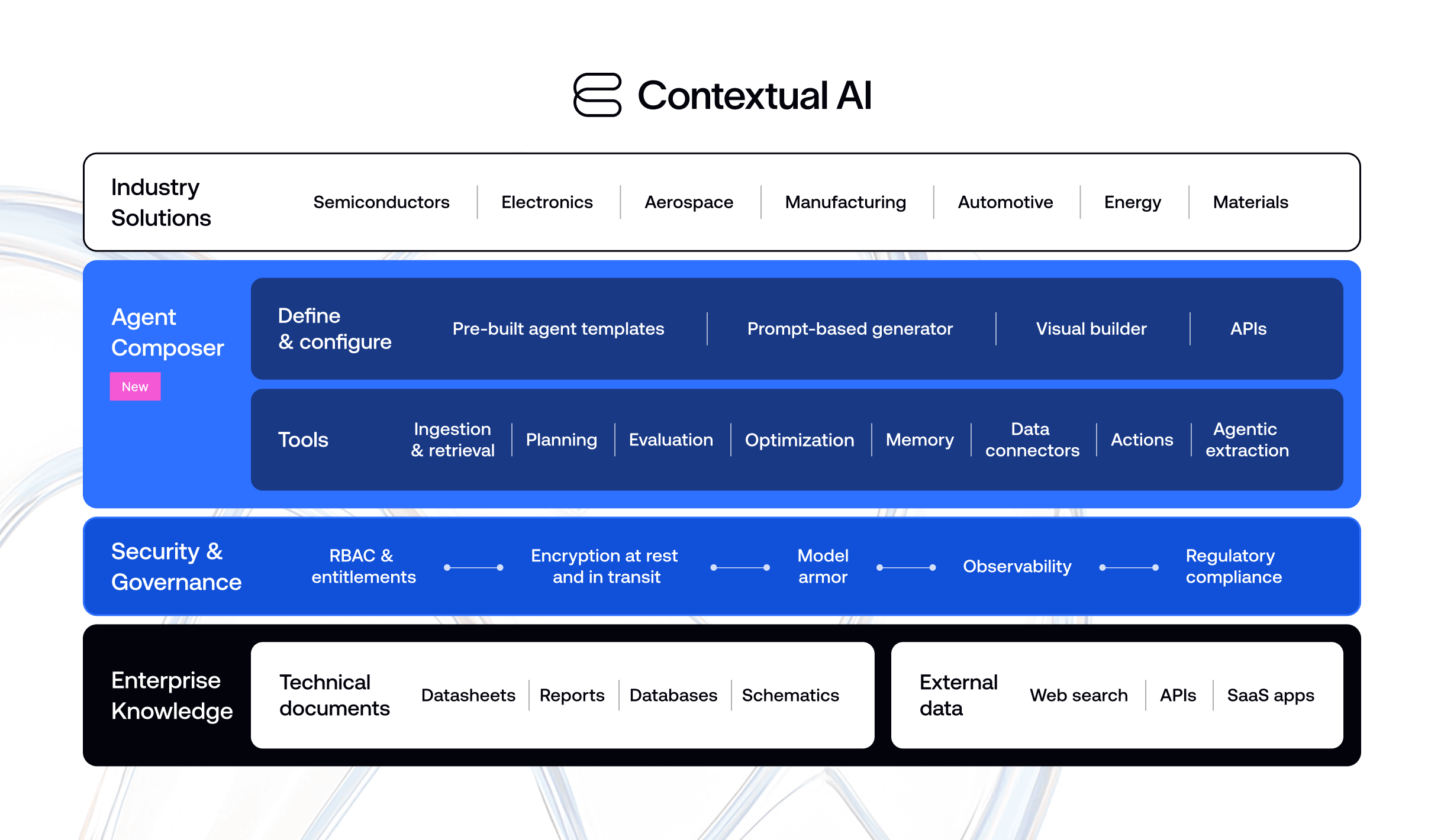
* **Pre-built agent templates** — Start with Basic Search or Agentic Search (self-serve) or use specialized templates for Root Cause Analysis, Deep Research, Task Execution, and Structured Extraction (enterprise).
* **Prompt-based generator** — Describe your use case in natural language and let the system generate an agent configuration.
* **Visual workflow builder** — Drag-and-drop interface for customizing agent behavior, adding tools, and defining multi-step workflows (enterprise).
* **APIs and Python SDK** — Programmatic access for integration into existing applications and automation pipelines.
The diagram below shows the full scope of Agent Composer capabilities across industry solutions, agent configuration, tools, security, and enterprise knowledge sources:
 ***
## Key Capabilities
### Multi-step Reasoning
Agents can decompose complex problems, execute multiple retrieval and generation steps, and revise outputs based on intermediate results. Unlike simple RAG systems that do single-hop Q\&A, Contextual AI agents iteratively refine their understanding—retrieving additional context when needed and cross-referencing information across documents.
### Multi-tool Orchestration
Coordinate retrieval across multiple sources within a single workflow: internal documents, structured databases, logs, web search, and external APIs. The platform handles both unstructured data (PDFs, manuals, specifications) and structured data (databases, tables, spreadsheets) through a unified retrieval interface.
### Customizable Workflows and Outputs
Configure agents to produce structured outputs tailored to your needs: investigation reports with ranked hypotheses, compliance checklists, maintenance plans with specific sections and artifacts. Define output schemas, required fields, and formatting to match your existing workflows.
### Hybrid Agentic Behavior
Combine fully dynamic agent steps (where the LLM decides what to do based on context) with static workflow steps (where you define the exact sequence). This gives you control and predictability where you need it while retaining flexibility for complex, open-ended tasks.
***
## Example: Device Log Analysis (Enterprise)
Complex workflows like device log analysis require correlating data across multiple sources—test logs, process history, design specifications—to identify root causes. This type of multi-source investigation is where Contextual AI delivers the most value.
With the Root Cause Analysis template (enterprise), agents can:
* Retrieve from all relevant data sources simultaneously
* Generate and rank hypotheses based on evidence
* Produce structured investigation reports with citations
***
## Key Capabilities
### Multi-step Reasoning
Agents can decompose complex problems, execute multiple retrieval and generation steps, and revise outputs based on intermediate results. Unlike simple RAG systems that do single-hop Q\&A, Contextual AI agents iteratively refine their understanding—retrieving additional context when needed and cross-referencing information across documents.
### Multi-tool Orchestration
Coordinate retrieval across multiple sources within a single workflow: internal documents, structured databases, logs, web search, and external APIs. The platform handles both unstructured data (PDFs, manuals, specifications) and structured data (databases, tables, spreadsheets) through a unified retrieval interface.
### Customizable Workflows and Outputs
Configure agents to produce structured outputs tailored to your needs: investigation reports with ranked hypotheses, compliance checklists, maintenance plans with specific sections and artifacts. Define output schemas, required fields, and formatting to match your existing workflows.
### Hybrid Agentic Behavior
Combine fully dynamic agent steps (where the LLM decides what to do based on context) with static workflow steps (where you define the exact sequence). This gives you control and predictability where you need it while retaining flexibility for complex, open-ended tasks.
***
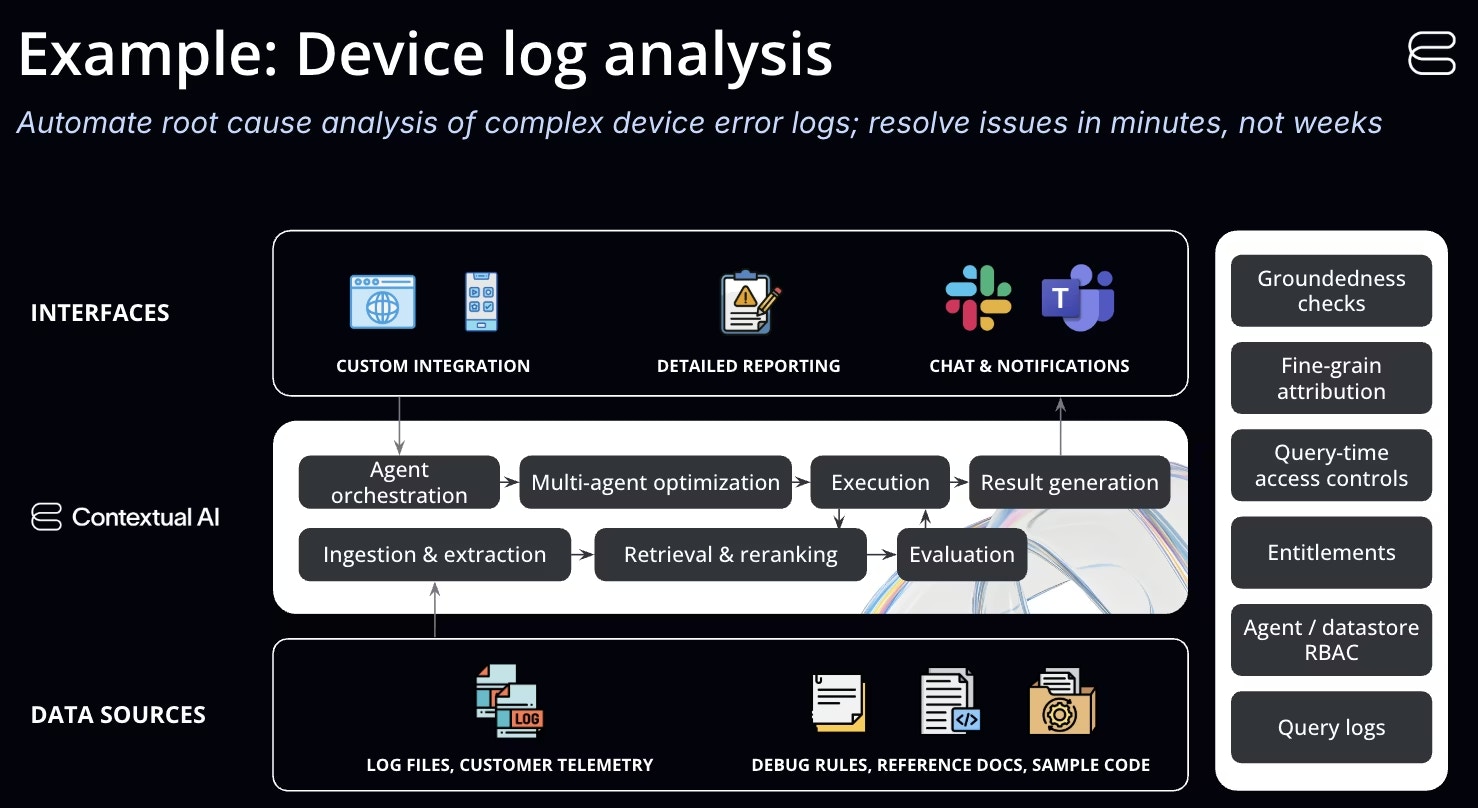
## Example: Device Log Analysis (Enterprise)
Complex workflows like device log analysis require correlating data across multiple sources—test logs, process history, design specifications—to identify root causes. This type of multi-source investigation is where Contextual AI delivers the most value.
With the Root Cause Analysis template (enterprise), agents can:
* Retrieve from all relevant data sources simultaneously
* Generate and rank hypotheses based on evidence
* Produce structured investigation reports with citations
 ***
## Get Started
Ready to see what Contextual AI can do for your team?
Sign up and create your first agent in minutes
Learn how to build custom agent workflows
**Self-serve** accounts include Basic Search and Agentic Search templates with full API access. For Root Cause Analysis, Deep Research, and other enterprise workflows, [contact our team](https://contextual.ai/contact).
***
## Get Started
Ready to see what Contextual AI can do for your team?
Sign up and create your first agent in minutes
Learn how to build custom agent workflows
**Self-serve** accounts include Basic Search and Agentic Search templates with full API access. For Root Cause Analysis, Deep Research, and other enterprise workflows, [contact our team](https://contextual.ai/contact).